Friday, May 19, 2006


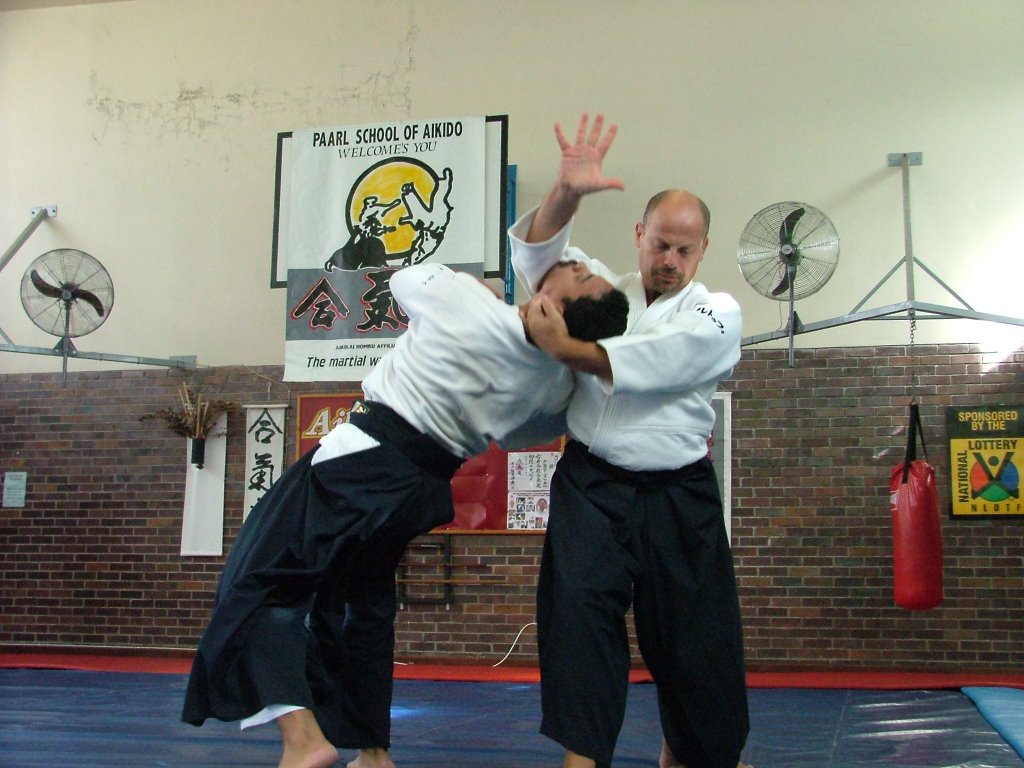
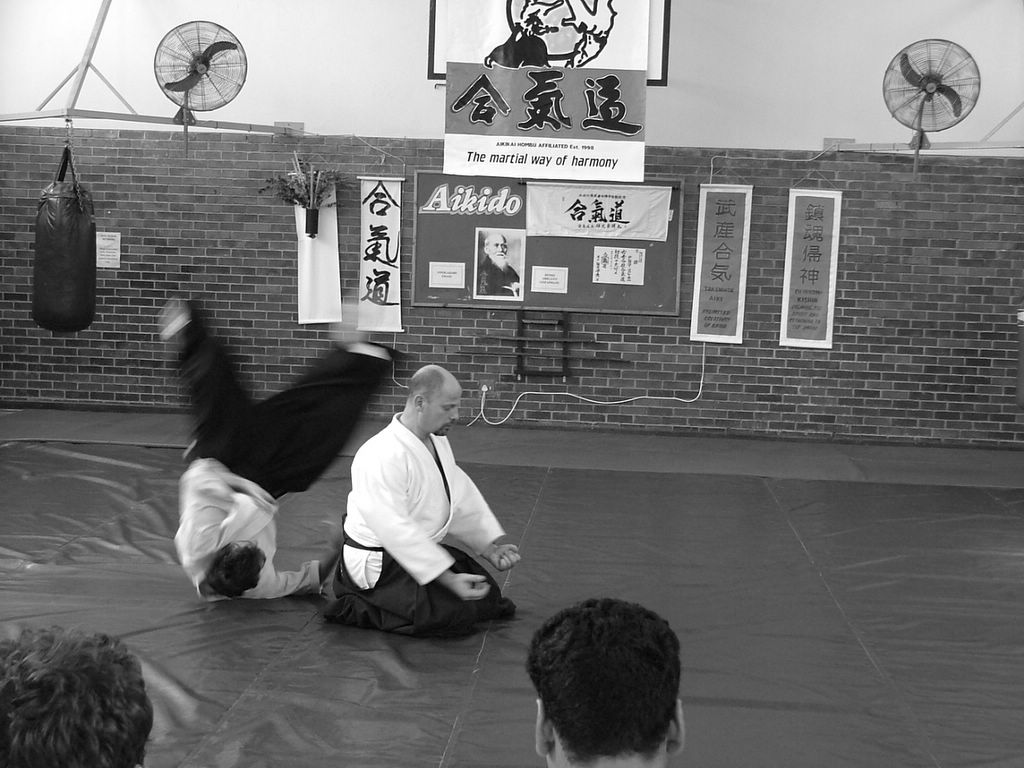
Sensei Franco Martuffi executing iriminage at the recent Regional course held in Cape Town

Friday, May 05, 2006


Suwari waza ikkyo

Sunset over Polokwane
Timing

This week I spent a lot of time in airport lounges as I traversed the length of this beautiful country flying from Cape Town in the South to Polokwane in the North, and back again. Only to return the following day to Johannesburg... And midway through the week was the start of a public holiday and an extremely long weekend for some. And that was when my timing failed me.
The exodus from Johannesburg began early on Wednesday afternoon, resulting in a traffic log-jam (and a miscalculation of the time required to get to the airport), and me missing my flight by about 7 minutes. It might as well have been 70! The result was the same - the cost of an overnight stay in an hotel; the frustration of being told that all 5 subsequent flights were oversubscribed and having my standby hopes dashed time after time; and the inconvenience of all those personal arrangements that had to be reshuffled. Now some 21 hours later, I am finally at 31,000 feet, winging my way home...

But it's got me thinking about the importance of getting your timing just right. Like most things in life, the Goldilocks principle (not too hot, not too cold, just right) applies. Get there too early and you risk frustration, boredom and the sense of a waste of time. Get there too late and you risk - well you already know what I risked... The aim is to get there just in time.

The central feature of Aikido - kokyo-nage (breath power throw) - relies on 3 legs for its effectiveness: timing, body placement and relaxed breath power. Of the three, getting the timing just right is crucial to the effortless execution of the technique we see so often in the demonstrations by Aikido masters and senior grades.

Start moving too soon and you telegraph your intention to your attacker who simply needs to change tack to clobber you. Leave it too late and you are likely to be overwhelmed by the force of the attack. Getting the timing, like Goldilocks, just right requires a connection with uke attacker) so that I move in the moment that the intention to attack me is actualised yet not completely formed. It means that I unsettle uke in that moment when s/he reaches for me by drawing her/him up or out.
Getting it 'just right' means maintaining the connection by matching the speed of the attack and blending body movements so that ultimately uke and tori (attacker and defender) move as one unit.
The effort tori puts in then becomes a higher level one - no longer merely physically ensuring that s/he is in the right place at the right time, but an effort at maintaining the connection with uke, nurturing the relationship... And when it is 'just right' the movement is beautiful to behold, easy to execute and a pleasure to enjoy.

So right now I'm going to sit back in to my seat, close my eyes and relish the fact that the pilot has just announced that he's gotten the timing 'just right' and that we'll be landing on time.

PS. Attached is another good reason to get the timing just right - the sunset in Polokwane just after we landed. Enjoy!!!

See you on the tatami!!

(read this and my other blogs at aiki4life.blogspot.com)
The Case of the Reluctant Uke

I came across this article on a very useful website (www.aikidojournal.com). I thought we should all ponder on our own practice - either in encountering a reluctant uke, or being one.


The following article was prepared with the kind assistance of Jon Aoki of the USA.

"For those of us not congenitally attracted to violence, aikido training sometimes presents problems that are difficult to ignore. The come in human form and in distinct personality types. Amongst these is the reluctant uke.

This is the guy who tries to block all your efforts to apply a technique and takes a smug delight in refusing to fall. He dedicates his time on the mat to trying to prove your techniques do not work. And sometimes he succeeds.

He may be new to aikido, having migrated from another martial art or, worse, some one with years of experience who knows precisely when to make himself totally uncooperative for maximum effect.

Typically he seems not to understand how meaningless and destructive his behavior is, and no amount of aikido philosophy gets through to him. He sees everything in competitive terms and believes that every technique must work regardless of the circumstances. Only rarely will he change his spots.

How many people have given up aikido because of him? How many women have been turned away from the art by his chauvinistic behavior? How many honest and sincere instructors has he caused to hang up their hakama, convinced they are not qualified to teach?

Sometimes the reluctant uke is amenable to reason and will respond to a pep-talk, provided it is delivered early in his career. He should not be confused, by the way, with the uke who holds firmly or strikes positively in order for both partners to research and discover the meaning of aikido. The difference is in the attitude and the intention.

Of course the reluctant uke can be dealt with physically, by a swift atemi or a painful and dangerous abbreviation of a technique, and some instructors have earned a fearsome reputation for meting out this kind of eye for an eye treatment, but many of us hesitate to respond in this way. Usually the effort to block a technique makes the blocker an easy target for a punch, but retaliation is not consistent with the aims of aikido, and could lead to an ongoing exchange no different from a contest.

My own son went through a period (thankfully short-lived) during which he became a very reluctant uke indeed. While I was slowly performing a technique in front of a class he would suddenly exert his full strength to block it halfway through. To respond with atemi was not really an option under the circumstances.

We also had a champion power-lifter in our class who used to apply his massive strength at the most unexpected times. Once when we were doing kokyuho he suddenly pulled my arms in towards him, enveloped them with his brawn and pinned them under his armpits. Aside from head-butting him or biting his nose-options I did not consider appropriate or necessary-I was powerless.

No doubt readers have had similar experiences and will recognize the type of attitude. It was a type neatly represented by a Chinese martial arts instructor I once met in Hong Kong. I only visited him at the suggestion of a friend who said the man would be glad to meet me and keen to exchange technical know-how. But, in the event, he was very suspicious and began interrogating me on my motives in coming to see him. I was about to flag the whole scenario away as another cross- cultural cock-up when he said, O.K., show me some aikido.

Thinking to start nikyo, I invited him to grip my wrist, whereupon he made the memorable and no doubt perfectly logical remark, from his point of view: Why would I do anything as stupid as that? He obviously saw the whole exchange as a challenge aimed at testing him or showing him that my technique was superior to his.

Unfortunately, many aikidoka have the same attitude- having missed the point of training by a country mile and having failed to see that aikido is defensive, not offensive and that its goals transcend winning and losing. When you take on aikido you must put aside the whole idea of winning and losing and focus on achieving harmony. You can't have it both ways.

Seeing aikido in competitive terms is like trying to prove something that cannot be proven. Occasionally even a Japanese will display this attitude, though the respect for authority in Japan generally migrates against this, and most Japanese aikidoka appear to accept the nage-uke (performer-receiver) cooperative system of training. One Japanese friend told me, under the influence of alcohol, that he would love to have just one shot at testing his sensei's skill by refusing to fall nicely all the time. He added that he was prepared to pay all his own hospital bills! In general, Japanese are more inclined to abuse their position as nage by thrashing their unfortunate and obedient ukes themselves, although I have met plenty of the latter in Japan.

What is so puzzling to me is not just the fact that people seem unable to think outside the parameters of a contest but that they confound training in the dojo with reality. Getting the reluctant uke to understand this is often a major challenge. (If only he would just go away and take up a competitive sport like judo or karate where he could block to his heart's content!) Aikido is not, after all, for those who feel the need to defend their egos at all times. We can, within limits, always learn something by trying to relate to these contrary individuals, but those limits need to be recognized, and going beyond them can be counter-productive to say the least.

Dojo training is not a life-and-death affair, and there are many things you cannot and need not do in the context of training. Just as you cannot do ikkyo on an elephant or kokyuho on a concrete wall, there are some ukes who cannot be thrown against their will without nage resorting to dangerous or violent tactics departing, in the process, from the principles of aikido training.

How you react is a measure of your training and your personal philosophy: a laugh or a smile may be enough. Though the urge to suggest, in one way or another, that these ukes get a life can be quite strong, we need to learn to take a metaphorical step back (which is also a sound technical approach) and to calmly refuse to play the reluctant uke's game. Even if you cannot do anything with him, it really does not matter, as it is only a game after all. Paradoxically, a realization of this fact is sometimes all it takes for the technique to actually work, but you should accept the fact that you can't win ‘em all.

When it is your turn to be uke and you feel you could stop your partner's movement, you should resist the temptation and allow him to compete his technique. What have you got to lose? What do you gain otherwise? Certainly you show your partner the inadequacy of his technique by blocking it, but there are more positive ways to encourage him and help him to improve.

Some instructors precede their demonstration of a technique with a realistic version, as opposed to the standard dojo version. This is a sort of a bad guy-good guy approach where you explain how to break an arm with ikkyo, smash a head with shihonage or mangle a wrist with sankyo – not forgetting the devastation that can be wreaked with powerful atemi. You then proceed with aikido…. But, in the dojo, we do it this way. While okay up to a point, this approach panders to the competitive mentality and can become an end in itself, to the detriment of the aikido spirit.

The competitive mentality can invade a dojo like a virus against which a constructive, harmonious training atmosphere offers little immunity. Newcomers feel intimidated and do not speak out, and often the instructor feels unable to do so either, without losing face. He may feel that he should be able to take all this in his stride, just as O-Sensei accepted challenges from all-comers in the old days.

Far better, I think, to acknowledge that we are not O-Sensei and that these are not the old days. It is the instructor's responsibility to protect his students from ignorant people and to ensure the dojo is a place where something worthwhile can be learned, and where students treat each other with mutual respect, not a battlefield for shallow egos intent on outdoing one another. The dojo should be a sanctuary where one can safely experiment with ideas and techniques that aim for a completely different outcome.

The difference between training and reality (and between a competitive sport and a martial way) is well illustrated by the aikidoka who responded to a challenge from a judo man by showing up with a live sword tucked in his belt. These days, however, it is not very practical to say it with swords whenever taijutsu seems inadequate, but another weapon, often underestimated, is the spoken word. Despite the stoic budo tradition which prizes the strong, silent type, I feel it is appropriate to speak up when one encounters the boorish, reluctant uke. This is by no means easy to do and calls for some resolve. It may not stamp out the breed but it may make life more tolerable for many members of the dojo, i.e., for those who really want to learn aikido and have no interest in competing. Left unchecked the reluctant uke just becomes more and more reluctant.

Unfortunately, the seniority system tends to intimidate beginners, who are the ones most likely to be affected by blocking and bullying, but I feel that remaining silent while someone is applying unnecessary force in the dojo is an outdated and inappropriate attitude. Furthermore, it is always better to use your tongue than your fists, and to use your brain before trying to brain someone else, or before they try to brain you.

Old attitudes die hard, as I found when visiting Japan recently. I was sitting with a group of students in one of the dojos I used to train in when somebody mentioned my articles in Aikido Journal. The sensei present said, "It is interesting that these days virtually anyone can write about aikido, whereas in the old days only the very top teachers dared to do so." (He actually used the Japanese words "were allowed to," which is revealing.)

Whether this remark was aimed at me (if the cap fits, wear it) or was just a generalization I do not know for sure. However, I believe anyone is entitled to speak or write about aikido, regardless of rank or experience. It is up to the listener or reader to decide how much credibility to give their words. Freedom of expression is just one of the planks of democracy that many older-generation Japanese appear to have difficulty with.

When it comes to O-Sensei-style mystical insight and any attempt to explain that in words, I would agree that he who speaks does not know and I would be the first to accept whatever divine punishment came my way if I even pretended I had access to that kind of knowledge. I suspect such punishment would not be as dramatic as a bolt of lightning, but would more likely take the form of a gradual slide into even greater ignorance. You would end up like the proverbial man without a torch, in the coal-cellar, searching for the black cat – that isn't there! In that sense, ignorance is its own reward. It is risk one has to take when opening one's mouth on anything, but this should not stop anyone protesting at glaring breaches of the aikido spirit.

Coal-cellars aside, there is a dark side to aikido which is typified by the reluctant uke, and if senior exponents have become blasé? about it, then it is important for newcomers and those who can still see it clearly to show it up by whatever means they can. They have as much right as anyone else to speak up.

Experience does not automatically lead to enlightenment, and some senseis talk utter rot while some ordinary people have far more wisdom to offer. It is a sorry delusion to assume that people with long experience of aikido are somehow superior. Likewise, any unwritten rule that prevents a person from protesting about that abuse of power by those in high places should be relegated to the garbage heap of worthless traditions.

The danger of becoming psychologically desensitized to violence increases every time it is ignored and we need only look at what is going on in Europe right now to see the end result of this attitude.

The old Roman adage si vis pacem para bellum (if you want peace prepare for war) is another bit of traditional wisdom that does not fit the observable facts. Preparation for war has always led to war, and it is depressing to see this borne out even as we speak.

We should thank our lucky starts that we are able to practice aikido, where the opposite aspect of the human spirit is manifested.

The least we can do is to try and maintain peace and harmony in our aikido training, insignificant though this may seem in comparison with the scale and horror of the current destructive global events.

There is more than enough conflict in the world already.

Let us see if we can find another way."


__________________

Aikido is, in the words of O-Sensei, a way of training the body and the spirit. For this reason our practice on the mat can never be divorced from our practice of Life. Our approach to one will be reflected in our approach to the other. And our experience in one will definitely influence our experience in the other. It therefore stands to reason that if there is some aspect of our life that we would like to improve, by practicing consciously and with awareness on the tatami, we could effect a change - or even just explore the limits of ourselves and our baggage.

Hope to see you on the mat soon,

Ghalib

Thursday, March 30, 2006

It always amazed me. She either could see things that I could not see or she had an unquestionable trust in the order of things. She wasn't reckless but only acted as if each step was a new beginning. What happened next could not be determined until the beginning had happened. Each moment and each step was not predetermined or premeditated. Each moment and each step determined her presence in the only things that existed then, that was the moment to which she gave her attention. She couldn't relive it and certainly didn't have the time to stop and think about it now. It had no value. She also couldn't worry about twelve steps ahead because she was only able to focus on the uncertainty and the experience of the moment. There was no time for the future, a future that could not be predicted with the same certainty as experiencing the present.

It was amazing and beautiful. It seemed like reckless abandon; yet it seemed like every step was well choreographed. There were no slip or miscalculations. It seemed like she had done this a hundred times before and was now doing it for the hundredth and first time with her eyes closed. But I knew this was not so. We had not been here before.

There was no time for her to plan a course of action. There was no time to plan a course of action. There was no time for her to pause and plan her next step. It was all happening in a smooth and spontaneous manner. It was happening in the present moment. It was as if you were jumping from lily pad to lily pad - unable to stop for a moment for fear that you will sink. However, for her it seemed that at each jump there was also a sensory assessment of the current situation and a spontaneous adjustment for the next moment.

I don't know how it is done. I don't believe that it is a reckless act. My sense is that there was a desire to enjoy the romp and to release to the care of the Fates. If disaster were to strike, it would be dealt with in that moment. If disaster were terminal, there would be no concerns after that.

Molly, golden retriever, was my teacher at that moment during our walk through the woods. For Molly it was a joyous romp through the bushes, down the slopes, through the creek, and from rock to rock - an adventure that for me was the necessary exercising of the family dog.

(Aikido for self discovery, Stan Wrobel)


Life is full of surprises. And it requires of us an awareness that is similar to dancing on a shifting carpet.

Today at class, students were practicing their ukemi (break-falls). This included sliding into a rear break-fall under a sweeping jo (short staff). One student moved too slowly, too stuck in his position to move out of the way in time and ended up colliding with the jo, not hard mind you, but hard enough to smart and to stop him. Any number of factors could have caused the collision: thinking too long and too much, hesitating - and then being lost, a break in concentration and awareness, or indeed wanting the situation to end in a particular way when the circumstances did not allow for that.

Too often in life we remain attached to a particular outcome - even in the face of evidence to the contrary - and doggedly pursue OUR outcome often at great cost to ourselves.

On the mat this sometimes shows itself as a forcing through a particular technique - regardless of whether we clash with our partner (uke) - even if this means that we resort to overpowering uke with brute force. This then starts a downward spiral which ends with might being right. The short-term goal might be achieved - my opponent is down - but the long-term damage to the relationship might be irreparable.

In life, attachment to a particular outcome can show itself in everything from arguing a point just to be right through to schoolyard bullying or cause us to "pre-emptively" invade another sovereign country on the flimsiest of pretexts at great economic, social and human costs.

Aikido teaches us that we need to embrace the surprise, the uncertainty, the constant change in life through self-awareness, a trained body and an open attitude. It requires of us an integrated approach. Aikido requires us to interact with our uke second-by-second, reading his/her intention off his/her actions. It also requires us to be flexible and confident enough to adjust what we are doing to what is more appropriate, knowing that the ultimate outcome will be fresh, new, different perhaps to what either of us anticipated, but a constructive outcome nonetheless. It also helps us realise that at the end of every engagement, both uke and tori will be changed individuals.

Attachment to a particular outcome ultimately leads to a stuckness, a hardening of our position and our bones, a poke in the eye or death. Training in Aikido requires us to engage with both uke and life in a passionate, energised way that welcomes and embraces surprise.

Enjoy your training


Ghalib

Tuesday, March 14, 2006

2006 started with a bang - or more precisely a spark, a flame and ultimately a conflagration that engulfed much of the Peninsula. A chance cigarette butt, tossed negligently out of a car window wreaked havoc on the mountainside causing huge damage, leaving very visible blackened scars and even causing the death of a British tourist who was overcome by the smoke.
Even now, as I sit here in a farm-house in the Overberg the devastation of another fire is all too visible. Around me about 400 hectares of the unique fynbos vegetation of this part of the world was destroyed. Only quick thinking of the owners ensured that the farm-houses survived the flames.

This season of flames, of seeing nature's fury night after night from my balcony in the city, made me think of the elemental nature of our training. We're constantly balancing the four elements - fire,air, water and earth - in our training. Fire fills us with the passion and inspiration to practice, air (or kokyu rokyu) ensures that we have the relaxed connection to the universe that allows us to act without attachment, water gives us the flow to move circularly emulating the spirals in the universe and earth ensures we are grounded squarely in proper technique and good posture to channel all of this energy.

In order to gain the full benefit of our aikido training, it is necessary to find the balance between these elements - too much fire and we risk overheating and burning ourselves up (and possibly destroying uke); too much air in our practice and we may forget the realities of actual combat or a self-defence situation; too much water and our techniques lose the focus we need to take control of the situation; too much earth and we remain stuck in the face of an attack, unable to move quickly enough out of harm's way. So it is in finding the balance between these elements that the secret lies hidden. And for each of us that balance will be different because we may already have an excess of one or more of the elements. Through our practice then we need to awaken the dormant elements and calm down the hyper-excited ones.
As we practice and become aware of our own and others' actions and reactions, we will start to change - where we might have been shy and retiring, we may find ourselves moving more confidently; where before we might have brash and impulsive, finding the balance calms us down and makes us more thoughtful, strategic.

Just like the seasons are changing now and the blazing summer heat makes way for slightly cooler evenings of autumns and the plants gear up for the hibernation that winter brings, so too each of the elements are important, essential even and appropriate at different times. Knowing how to act appropriately and equally importantly, when to do so, is the product of a self-awareness, and a confidence that comes with regular practice.

See you on the mat

Ghalib

Wednesday, July 20, 2005

The Sunday Semnars spring from the advanced aikido classes held every Sunday morning at the University of Cape Town.

Aikido is a Japanese martial art, called the Art of Peace or the Way of Spiritual Harmony. These Sunday Seminars are a way to create the space to reflect on Aikido as more than a series of physical activities and exercises, but rather a modern expression of budo, the way of the warrior.

All martial arts share as their end goal, the improvement of the person, the sharpening of the sword within to be put to use in the service of the greater good. So if you too wish to explore these themes, or think about yourself in relation to others in a different way, why not join us next Sunday at 10h30.

If you are not in Cape Town, why not leave a comment on the blog, share your insights, your experiences, your thoughts.
Ghalib Galant, 2nd Dan

Sunday, July 10, 2005

Sunday Seminar 09 July 2005

Today we practiced ten-chi nage (heaven & earth throw) inspired in part by O-Sensei's words:

"Always try to be in communion with heaven and earth; then the world will appear in its true light. Self-conceit will vanish, and you can blend with any attack".
In its practical application, tenchi-nage consists of leading uke in two directions at once - up to the sky and down to the ground - thereby upsetting his/her balance and making easy the resultant throw. Tenchi-nage can only be practiced, like all of aikido I suppose, with confidence. That self-confidence only comes with rigorous and regular training. Entering with confidence however is not the same as violence; often we mistake violence for effective technique. Confidence comes from self-knowing; it springs from trust; it arises from practice and reflection.

And herein lies the difference between an initial fumbling with the mechanics of the movement and a deep appreciation for the subtleties of the application.

Tenchi-nage again shows us that in order to engage successfully with uke, we need to commit our whole body, our whole being in fact, to the moment. It may be possible to unseat uke by moving just our hands apart, but the true beauty, the truly spiritual nature of this technique becomes apparent only when that movement involves the whole body moving in concert, the right hand rising along the centre line (not inscribing an arc), the left mimicking the movement of the left foot as it slides off the line to come to rest at uke's point of weakness, uchi-gawa.

This commitment requires that our whole body be involved; it is so easy to withdraw the extension from the bottom hand (in this example the left hand) as uke's balance is broken.And then to rely on the force of the top hand to push uke over and down. Contrast that feeling with the one where by extending strongly through both hands and by moving from your central point (tanden), uke's balance is broken and the technique finds easy completion.

By remaining grounded and true to ourselves (confident extension through the bottom hand), we do not have to resort to violence and force to achieve our objective (upper hand). In fact, by being well grounded we are able to free up ourselves to engage constructively with uke; indeed we free up our higher selves in order to meet aggression with gentleness, anger with love, fear with openness, hurt with compassion.

The name tenchi-nage gives us some inkling that this is a technique that teaches us about the innate duality within all of us - hard/soft, yin/yang, male/female, light/dark. Ultimately it is not so much transcending our baser (earth) nature to embrace our higher selves (heaven) - that happens when we die. Tenchi-nage is about reconciling that duality within ourselves in a way that allows us still to move freely and engage openly with our life on this plane.

Tenchi-nage understood in this way is an incredibly spiritual space, but one that seeks to teach us how to live in this moment, on this day, with this person while remaining true to our own purpose.

Monday, July 04, 2005

Sunday Seminar 02 July 2005

Connecting .... and connecting ... and connecting

Every time uke attacks tori a relationship is created - and like any relationship it should never be a one-way street. Any good relationship requires both parties to be alive to the needs, expectations and the aspirations of the other. This does not mean that hose needs, expectations or aspirations HAVE to be fulfilled by the other partner; s/he should at least be aware of them, before deciding how to respond. So too in Aikido must the parties be aware of each other.

In order to execute any Aikido technique effectively it is crucial that the relationship between uke and tori remains a dynamic, vibrant one. Should either uke or tori become stale and stiff either in their attack or their defence, the technique equally becomes stale and stiff and forced.

In order to respond to the needs of uke, in order to fully respond to uke's attack, tori must remain alert, aware and above all connected. This notion of connectedness is central to any understanding of Aikido. O-Sensei often speaks of an attacker being already defeated in the moment of the attack because s/he is out of synch with the universe (and equally that tori is completely in tune with the universe) - so without this awareness, without this connection, there can be no aiki relationship.
At the risk of thinking in a linear (non-aiki) way, perhaps it's useful to think of the connection as having three phases: before, during and after.

Before
The first time you meet someone, subconsciously you size them up, your brain registers all sorts of details about them, you also decide whether you like them, want to get to know them a little (or a lot) better and whether they pose a danger to you or not. You also have any number of physiological responses - from sweaty palms to abject fear to utter joy - to them.
It is in this tumultuous moment that your relationship is born; how it develops is up to both of you. And that is why your response is so important. Intuitively, we step back in the face of an attack; aiki training teaches us instead "when an opponent comes forward, move in and greet him; if he wants to pull back, send him on his way"
What we do in this moment before the first physical touch, how clearly we connect with our uke will set the tone for the whole interaction. At a technical level this means getting the timing, body placement and breathing just right for our first irimi or tenkan movement; at a whole different level it means opening up our very being first to the possibility of, and then to the reality of the interaction and in that split second to embrace the moment joyously. And to move.

During
During the attack, from the moment of almost touching to the resulting throw or hold down, tori's awareness must be constant, maintaining the connection with uke for it is at this point that uke is most likely to want to change tack as the surprise at tori's response settles in. Tori should be aware of the messages coming to him/her from the points of physical contact but also from the stiffening of uke's body, his/her breathing etc.
It is often at this point, once s/he has taken the initial control that tori will lose the connection. The temptation to carry on through with what tori has decided will be the technique, will be great, its execution seemingly pre-determined. It is also at this moment, if we withdraw our awareness of uke, that we risk hurting uke through a misplaced projection or an inappropriate take-down. O-Sensei teaches that "to injure an opponent is to injure yourself. To control aggression without inflicting injury is the Art of Peace".

After
But the connection remains even after the throw or the hold-down is complete. Just as the connection began before the technique was formed, so too it lives on after the physical technique is performed. Ongoing awareness, zanshin, is necessary after an attack to ensure that the attack has indeed ended - both in the physical sense, and in the mind of uke. It is necessary in a higher sense to enable us to achieve a deeper sense of humanity, of engagement and of interaction with the world and the people around us. Zanshin in one sense is the notion of ubuntu that we cherish at the southern tip of Africa - I am who I am because of the quality of my relationships with others. Being sensitive and aware of others and of what they mean to us (on the tatami I cannot practice without uke and therefore cannot sharpen my skill and my soul) means that I become a better person. We need to appreciate that even in an attack - or in a death or departure - there lies a gift from uke as it shows us something to work on or something to celebrate. So the true zanshin, the real follow-through lies within.