Showing posts with label aikido. Show all posts

Tuesday, May 14, 2013


Between Form and Structure


Between white and black there is iridescent green and brown.
When flow meets structure, the river sings
Creating its own melody: quick, quick, slow, slow
Oh so slow, quick, slow, quick.

Where flow meets structure, new life emerges
In crevices and cracks, transforming meeting
Places into miniature verdant living spaces.

When form meets structure, there is movement
Over stillness – and stillness creating new movement.


Deep potholes form as transported little rocks
Jostle each other in the flow,
Where flow and structure meet.

Rocks liquefy, droplets solidify
In the touch both are transformed.
Time is the ever-present partner
When flow and structure meet. 

(ghalib galant 2013)

Tuesday, December 11, 2012

The Path is exceedingly vast

This past week I came across an interesting piece written by a fellow aikidoist from this Southern tip of Africa. It is at once an emotive and emotional piece by one of the senior practitioners of the Art in South Africa. As Chief Instructor of the Aikido South Africa organisation, what he says carries a fair degree of weight, not least of all for the influence he holds over students affiliated to that organisation.

Dr Goliath is one of the most passionate aikidoists I know,  as well as one of the technically most accomplished I have had the privilege of training with over the past many years. And certainly his dedication and commitment to his training should serve to inspire new and old students alike.

Entitled "My Path with Fujimoto Shihan (8th dan) - The Establishment of Aikido South Africa (R) NPC" (Click here to download the document ), I was looking forward to reading about the impact that studying under Fujimoto Shihan for the past decade or so has had on him - both personally and in terms of the meaning of Aikido. Along the lines of that really insightful and entertaining read The Swordmaster's Apprentice by Edward Burke.

I was therefore saddened as I read the long, brave document: 'long' because it runs into 43 pages, 'brave' because lays bare the deep hurt and pain that has dogged his 19-year journey with Aikido. Instead of a homage to his teacher, I found a piece that was filled with frustration, hurt and anger fuelled by a quest for recognition and validation. A validation that he did not find within AFSA over the 15 years he was associated with that body, and that spurred him onto establish ASA. That would be fine, except for how that anger and hurt causes him to lash out in his writing in a hurtful, violent, disrespectful and, to my mind, un-Aikido manner. 

For that is the crux of my reflection: our training in Aikido precisely seeks to equip us with those responses that are non-violent, protect even our attacker and transform (not merely resolve or manage) those conflictual situations we find ourselves in. Our training is precisely to overcome the classic 'fight-or-flight' responses hotwired into our beings and to give us the option to flow with whatever experiences we have in the moment - and to choose the nonviolent solution. Nonviolence is not a passive acceptance of everything; rather it is a conscious choice to respond and relate to the situation/attacker in a way that does no harm whilst still respecting one's own integrity and whatever is going on for you. 

Intentionally crafting something that attacks another and intentionally causes pain without recognising our own motivations smacks of a lack of self-awareness and of the compassion that lies at the heart of aikido training.  I will not deal with the organisational and other misrepresentations - of which there are several - that I see in the piece - save to say that I acknowledge that those misrepresentations arise from a deep wound aggravated by his experiences within AFSA. 

Training in Aikido is an intensely personal affair; it is not a team sport. While one relies on one's partner to provide an honest attack and response, one's practice is about refining oneself - in relation to the attack. O Sensei famously stated that he was not able to be defeated, not because he was a formidable technical martial artist, but rather because he was in harmony with the universe - something his attacker was not. Ai-Ki-Do has at its centre the notion of Spirit (Ki); the art is not one merely of training the body towards technical competence. It is true that aikido practiced with spirit and no technical competence is ineffectual; aikido practiced with technical proficiency and no spirit is at best brutish and bereft of the transformative power that lies within the physical practice. 

It is interesting to reflect on these words also by O Sensei: 
"The appearance of an 'enemy' should be thought of as an opportunity to test the sincerity of one's mental and physical training, to see if one is actually responding according to the divine will.... Our enlightened ancestors developed true budo based on humanity, love and sincerity: its heart consists of sincere bravery, sincere wisdom, sincere love and sincere empathy. These four spiritual virtues should be incorporated in the single sword of diligent training; constantly forge the spirit and the body and let the brilliance of the transforming sword permeate your entire being". 

As on the mat when facing a committed shomen-uchi attack, in Life too when confronted with situations that are violent and aggressive, unfair, or downright rude, the practice is NEVER to respond in a like manner, beating the opponent to the punch because you are bigger, faster, more technically capable than him/her. This competitive spirit was anathema to O Sensei in his mind being relegated to the domain of sports. So on the mat we are not in competition with uke; uke presents us with an opportunity to examine our fear, anxiety even our exuberance in our response and to work on the obstacles inside us that prevent us from blending and flowing. This competitive spirit is equally out-of-place between teachers, between dojos or between associations. "My teacher is better than your teacher" is OK for a 1970s grainy martial arts movie; it has no place in the sincere practice of aikido today. Indeed we do ourselves the greatest disservice when we adopt such an attitude. 

"The Path is exceedingly vast", O Sensei said. "From ancient times to the present, even the greatest sages were unable to perceive and comprehend the entire truth; the explanations and teachings of masters and saints only express part of the whole". For this reason it is important to train with humility; and equally to teach with humility. Anyone who claims to have found the Way can be assured that s/he has not say the Taoists. No path is better or worse than another - all paths lead to the Tao/Do. What we choose is a path in our aikido practice that speaks to something deep inside us. And a teacher who expresses this. And we are extremely lucky when we find such a teacher who is able to help put us in touch with that core essence of aikido (or whatever the practice is in fact) - in other words are able to bring us in closer touch with our essential being, with our common humanity, with our oneness. A teacher is someone who helps strip away our arrogance, our delusions, our fears and anxieties to introduce us to that beautiful core of compassion within us all. This does not depend on rank or hierarchical standing; it has more to do with being rather than doing. 

And therein lies the immense responsibility for anyone who assumes the role of teacher (or Sensei).  Someone in that position - whether delegated or assumed - has the responsibility to do more than show good techniques; s/he has to embody the spirit of the principles of the practice in how they relate to others - and their students. 

We all are flawed; the Path is exceedingly vast. We therefore need to make way for each other along that Path. 
 
 
"So let us consider together, those of us who can communicate, whether it is at all possible totally to end every form of violence  in ourselves and still live in this monstously brutal world. I think it is possible. I don't want to have a breath of hate, jealousy, anxiety or fear in me. I want to live completely at peace. Which does not mean that I want to die. I want to live on this marvellous earth, so full, so rich, so beautiful. I want to look at the trees, flowers, rivers, meadows, women, boys and girls, and at the same time live completely at peace with myself and the world. What can I do?
If we know how to look at violence, not only outwardly in society - the wars, the riots, the national antagonisms and class conflicts - but also in ourselves, then perhaps we shall be able to go beyond it."  -
 KRISHNAMURTI

Monday, August 09, 2010

Strike a Woman, Strike a Rock


August 9 is National Women's Day in South Africa. It is a day to celebrate the contribution to the struggle against apartheid made by many selfless women both in South Africa and in exile. It is also a day to remember the current struggle of women in this country to be accepted as equal to their male counterparts.

On the tatami, men and women train together. In aikido we are constantly reminded to consider the capacity of our partner – regardless of whether they are male or female. Our practice is really learning to accept uke for what he or she brings to the technique. We block our own learning when we train differently depending on whether uke is a man or a woman, and make assumptions about their capacity based on our own firmly held stereotypes and projections.

Valerie A Pinto, a Yoshukai karate teacher talks of how she, as a woman "coming up though the ranks as the only woman in our school, I had to work twice as hard as the men to be accepted by them. To actually earn their respect was even harder. I didn't have the power and strength most of them had, so I depended more on speed, agility and striking with precision. "

After years of training women survivors of rape and assault self-defence (a combination of karate, aikido and hapkido) she is still amazed by the reaction of her women students who say "you are not what I expected....". She maintains that "First I am a woman; as a very close second I am a martial artist.... I feel as women we need to be proud of who and what we are, and to let other women know that we are not different or special and that they can join us and, as women, help us share the power...."


Finally, a poem by Valerie Pinto, inspired by her students:


Are we Women
frail and afraid
protected from this cruel world
by the men we love

What happens to us
when the love is gone
when our father dies, our brother rapes us
our lover would rather hit than hug
who will protect us now?

We are Women
in our women's bodies
never educated in the aggressive and physical
world of men

But we are not frail
we are not weak
we have a great inner spirit
and we will not be afraid

If we learn to use our strengths
against the weaknesses of our oppressors
as David slew Goliath
we can change the balance of power
internally and in the world around us

We must become one
with our body, mind and spirit
We must learn to defend ourselves
and love ourselves

We're our only protection
against this angry world
and as sisters we must spread
the word and skills
we must spread the power

We walk together or alone
aware and unafraid

--Valerie A Pinto

(taken from "The Joy of Sharing the Power" by Valerie A Pinto in Martial Arts Teachers on Teaching by Carol A Wiley)


Wednesday, May 21, 2008

Some Thoughts on Grading Examinations


From Shihan Ken Cottier (7th Dan)

I have been surprised on a number of occasions by just how badly some students take a failure. On the other hand I have been happy with the mature way in which some have reacted to a disappointment. (I should point out that I have never given a grading in Britain and am referring to my experience in Hong Kong.) I remember that there was one fellow I failed and I actually expected that he would give up Aikido when I informed him. On the contrary, he responded with a smile as though saying "Not to worry: there's always the next time".

Some may feel that they have been treated unfairly in that they have held their present grade much longer than some who have advanced to the next one. But have they been practising, say, just twice a month as distinct from, say, two or three times a week as in the case of those who have moved ahead of them? Another important factor to consider is what level of instruction is one receiving. In other words, some may be under the watchful eye of a senior yudansha, whereas others receive their instruction from perhaps a 2nd or 1st kyu. Some, too, use class time more constructively than others and may even practise at home.

Once, on failing a lady, I asked her how she felt she had done. Since I felt she had not been even near the borderline I did not expect her answer "very well". So what does this tell us? Well, to me, that the examiner sees a lot more than the examinee.

Let's advance on this. Student 'A' makes a number of mistakes in the techniques but get everything else (distance, timing, coordination, manner, etc.) right. Student 'B', on the other hand, makes no mistakes in the techniques but gets everything else wrong. If we observe a 3rd kyu, shodan, sandan and rokyudan executing shiho-nage, although basically they are all doing the same thing, there are differences between them.

Then there are those who almost demand to be graded in spite of having reached a stage where they do not seem to be able to progress any further for reasons such as past injuries, age, attendance or attitude. In the case of such people I sometimes wonder why in practising with people of the same grade or of lower grades, they cannot evaluate themselves. Then there is the opposite of this when students of a certain grade refuse to go further. In the days when I practised Judo there was one fellow I remember who stopped taking grades at 1st kyu although he probably reached nidan level. He used to delight in flinging dan grades around!

In awarding grades I do take into consideration age, in that I do not expect a 58 year old student to perform in the same way as a 20 year old. As for yudansha I look for a lot more than technique as I feel that a hakama in the wrong hands, so to speak, can do a lot of damage to Aikido, especially in areas where a shodan grade is quite significant.

Some years ago we had in Hong Kong a very good, very big, very strong student whom everyone enjoyed practising with. In other words, nobody was afraid of him. To me this said a lot when I came to grade him shodan. In Hong Kong all those wishing to try for shodan must first discuss it with a senior grade (we have 5 yondan) - usually the one who has most influenced them.

Hong Kong is often referred to as the crossroads of Asia, it being the stopping-off point to Japan, Taiwan, China, Thailand, the Philippines, etc. On visiting the dojo I have often found that we had a visitor from abroad. Over the years some that sported hakama in my opinion were not of dan grade standard. Nevertheless I have always welcomed them and not made them feel uncomfortable. After all, it is those who awarded such grades who should be accountable. I constantly tell our students that if they visit another country and are below par, it is me that it reflects on.

In conclusion let me say 'do not worry about grades unduly: they will come with the years'. Some of you may feel - as once I did - that you will never wear a hakama. But excluding accidents or other unforeseen circumstances, you will.

(First Published in the British Aikido Federation Newsletter, December 2002, No.43 - All Rights Reserved)

Friday, January 04, 2008

The Still point

This first entry of 2008 comes with the swish of waves lapping on the Camps Bay shore at 10h30, the feel of fine sand between my toes and the gentle heat of the UV rays on my shoulders ensuring that my natural brown goes even more bronze... Ahh the joys of modern mobile telephony...

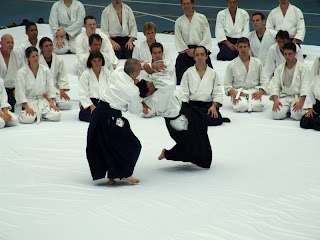
Last night on the mat we practiced a number of techniques, including a fairly basic shiho-nage (4-corner throw) from katate-dori. Imagine, if you will, you are in left hanmi; your attacker reaches out to grab your left hand, whilst preparing to strike you with his right hand. You step in a rearward circle, drawing your left foot back and to a position 270 degrees to its previous position. This draws your attacker (uke) into the signature circular movement of aikido. You draw your hands to your centre, collect uke's outstretched wrist, raising it to your forehead before stepping forward, swiveling and throwing uke to the ground.


The circular movement makes a lot of sense: the hub of a wheel moves very little, while the outer rim has to move relatively, faster and further. Keeping uke then on the periphery of the circular movement forces uke to work harder to keep up.
While this is a fairly basic technique, it was that moment of quiet just before you raise your arms that struck me last night.

In that moment, as uke is coming around, centripetal and centrifugal forces conspire to cause gravity to lose its dominion and a curious lightness, even weightlessness seems to envelop both parties.

Minegishi sensei (6th dan) exhorted us at the recent AFSA 30th anniversary celebration training to look for that moment before uke settles back into posture. That is the moment to make one's move. Wait too long and you allow uke to regain his/her balance which you have worked to unsettle. Things become solid, staid, heavy and hard to move. Find that moment and your subsequent movements become light and effortless.


Finding the moment requires that you are completely present in the moment, that you are aware of everything that is happening between you and uke in that moment. You can only get there if you do not hold onto any one thing, but rather "listen" to everything happening - with your whole body.
it is also in that moment of quiet when all is still that the myriad possibilities of techniques or responses are revealed.


In Aikido, we are constantly looking for an opening, a physical gap into which tori can step or uke can fall. It is equally important to find that other gap where time and gravity stand still, and where softness resides. That is what takes your movement from technical proficiency to true artistry.
TS Eliot put it far better,and far more succinctly:

At the still point of the turning world. Neither flesh nor fleshless.
Neither from nor towards; at the still point, there the dance is....

Off the mat too, finding that elusive space of perfect stillness and quiet among the hubbub of our daily life, is also essential. Too much of our lives is spent reacting to events or stimuli, in knee-jerk reactions to things that happen without interposing or finding that moment of quiet to truly evaluate what is occuring. And then responding appropriately.

On the mat this results in a less than satisfactory technique or a painful experience for uke; in our daily lives it may also result in painful regrets or recriminations. The magic of the still point, and of the creativity locked within it and the range of choices it offers us, takes us from subsisting to truly living. In the same way that it uplifts your technique from being technically good to truly artistic, so too it permits us to experience the artistry of living a life more fulfilled.


So if you excuse me now, I'm off to find my own personal still point as the icy aquamarine Atlantic snatches my breath away as I dive into her embrace....

See you on the tatami soon

Ghalib

Tuesday, December 18, 2007

We arrive where we started and know the place for the first time...

TS Eliot wrote about the moment when “we arrive where we started and know the place for the first time”.

For me the recent 30th Anniversary celebrations and training of AFSA (the Aikido Federation of South Africa) in my hometown of Cape Town represented such a moment. The celebrations brought together 5 very senior instructors - Osawa Shihan (7th dan), Fujimoto Shihan (7th dan), Minegishi Sensei (6th dan), Martuffi Sensei (6th dan) and our own De Beer Sensei (5th dan)and nearly 150 practitioners from around the globe and the country.
That space at the foot of the imposing Table Mountain, Hoerikwaggo to call it by its more mystical name, that space where the idea of an aikido federation for South Africa was born presented an unique laboratory. A place to rediscover that feeling of first stepping onto the mat, of letting go of the familiar, the comfortable. A space to open the mind and try out new ways of doing things, of being reminded of old, sometimes forgotten, ways of doing things.
In short, it was a space to close off this cycle and start anew - and a new cycle.

For AFSA, the event marked 3 decades of training in South Africa. It also heralded a worthy celebration of our emergence from isolation. The past 30 years were marred by our physical distance from the rest of the world and for much of that time the isolation that came from being a political pariah on the world scene. The last decade - our decade of democracy - has seen a dramatic shift, a narrowing of the gap between us and the rest of the (aikido) world.

The next 30 years pose a big challenge for AFSA. This new cycle we are starting will place new demands on us - of growth, of living up to the theme of "training together under African skies". In a country of nearly 48 million only 2,500 know about or have tried out aikido. There rests a responsibility on all of us who love and practice this rather unique martial art to introduce it to more people and thereby spreading its message of dealing with violence differently, more constructively to a wider audience.

On a more personal note, the seminar also marked in some ways my own coming of age - after 21 years of training. This year I struggled to re-locate my centre. Because Aikido is much more than a series of techniques or exercises; because it is based on a philosophy that permeates every aspect of the art, it demands a degree of consistency throughout one's life - both on and off the mat. Thus, if the exhortation on the mat is to ensure that you do not hurt either yourself or your partner, that self-same principle has to apply off the mat too. This is even more true when one is cast in the role of instructor.

So even though all of us are people, and are therefore fallible and make mistakes, and thereby hurt people, failing to recognise the mistake, and taking steps to ensure that you do not repeat it, is critical. It is to that lack of consistency, that lack of authenticity that students react, even unconsciously. And leave. Similarly it is the consistency, the authenticity in one's practice that ultimately shines through. And so, a lesson for me from the 30th anniversary has been that no matter whether you are flamboyant or reserved, training in a way that is effective yet does not cause harm requires a stable posture, a foundation of fundamental principles if you like that informs everything you do.

From there springs the joy in training, that infectious spirit that brings aikidoists together and sets aikido apart from other 'ways'.
So here's to the next 21 years for me, the next 30 years for AFSA! Here's to making new mistakes - and learning from them- to growth and expansion... And most importantly....here's to seeing you back on the tatami soon...

Ghalib